Duolingo for Music: How ScoreFlip Gamifies Your Daily Rehearsals
Ask any piano teacher or professional musician: the hardest part of learning a new instrument isn't understanding music theory or developing manual dexterity. The hardest part is consistency.
Sitting down at the bench day after day to practice scales, chords, and arrangements can quickly feel like a dry chore. When the initial excitement of starting a new piece wears off, many learners lose momentum, let their instruments gather dust, and eventually give up.
When we designed ScoreFlip, we realized that the technology shouldn't just transcribe sheet music; it should help you actually practice and learn it. We set out to build a gamified practice dashboard—a "Duolingo for music"—that takes the friction out of rehearsals, turns static staves into interactive exercises, and rewards you for consistent daily play.
---
The Core Concept: The Habit Loop
To build a consistent habit, a system needs three components: a cue, a routine, and a reward. Traditional piano practice is high-friction (the routine is dry, and the rewards are long-delayed).
ScoreFlip gamifies this feedback loop by transforming practice into bite-sized milestones.
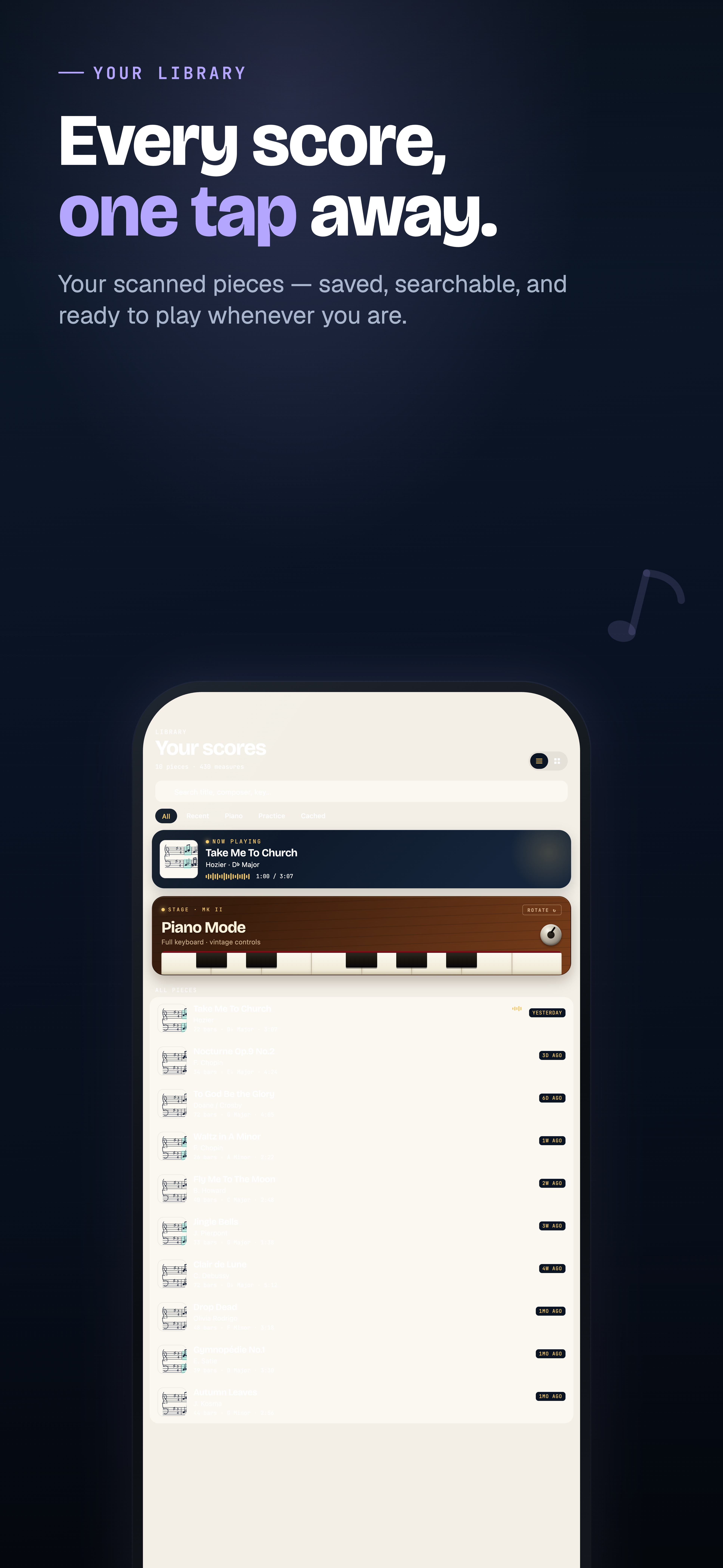
The main ScoreFlip Library showing catalog milestones.
Here is how the Practice Hub structures your musical progress:
1. Bite-Sized Exercises Rather than telling you to "practice the whole song," ScoreFlip allows you to partition arrangements into 2-bar, 4-bar, or 8-bar learning segments. You master these small pieces incrementally, like completing levels in a game, before combining them into a full performance.
2. Live Accuracy Feedback As you connect your keyboard and play along with the cursor, ScoreFlip monitors your timing and pitch accuracy. Notes played correctly light up in green, while misses show in red. The immediate visual feedback guides your fingers, preventing you from reinforcing mistakes.
---
Gamification Mechanics: Streaks, Stats, and Milestones
Like Duolingo, ScoreFlip uses modern engagement mechanics to keep you motivated and accountable.
1. The Daily Streak Nothing is more powerful for building a habit than protecting a streak. The ScoreFlip dashboard tracks the number of consecutive days you have practiced. Whether you play a full classical concerto or just run a simple scale for 5 minutes, your streak remains active.
2. Accuracy Scoring (XP for Musicians) At the end of every rehearsal block, ScoreFlip evaluates your performance and displays a score screen: - Pitch Accuracy (%): Measures how many correct notes were hit. - Timing Precision (%): Evaluates how closely you followed the tempo grid and note values. - Problem Areas: The system highlights specific bars or chords where you hesitated, letting you build targeted loops for the next session.
3. Progressive Milestones Earn achievements as you practice. Unlock badges for: - Speed Milestones: Playing a difficult run at 100% tempo. - Hands-Together Mastery: Successfully playing a piece with both hands synchronized. - Streak Milestones: Maintaining a 7-day, 30-day, or 100-day practice streak.
---
Why Gamification Works
Traditional practice isolates you. You play alone, and it's hard to measure if you are actually improving day-to-day. By translating your performance into clear metrics, visual keybed lights, and streak counts, ScoreFlip makes progression visible.
You no longer have to guess if your sight-reading is getting faster or if your finger timing is more precise. The data is right there on the screen, and watching your accuracy score climb from 60% to 95% provides a powerful sense of accomplishment.
Learning sheet music doesn't have to be a dry, academic hurdle. By turning your piano keyboard into an interactive sandbox, ScoreFlip turns practice into a game you actually want to play every single day.
Enjoyed this deep dive?
Explore more articles on notation scanning, electric keyboards, and gamified music practice in our journal.
Explore All Articles